The Honeywell HPA300 is a sensible buy for a large room if you want straightforward filtration and simple controls. That answer changes fast if the room is small, the unit has to sit beside a bed, or you want the lowest possible upkeep. Buyers who want app control, automatic sensing, or the quietest bedtime setup should look elsewhere. Buyers who need one purifier to work hard in a living room, basement, or pet-heavy space stay in the conversation.
The Short Answer
Honeywell HPA300 review
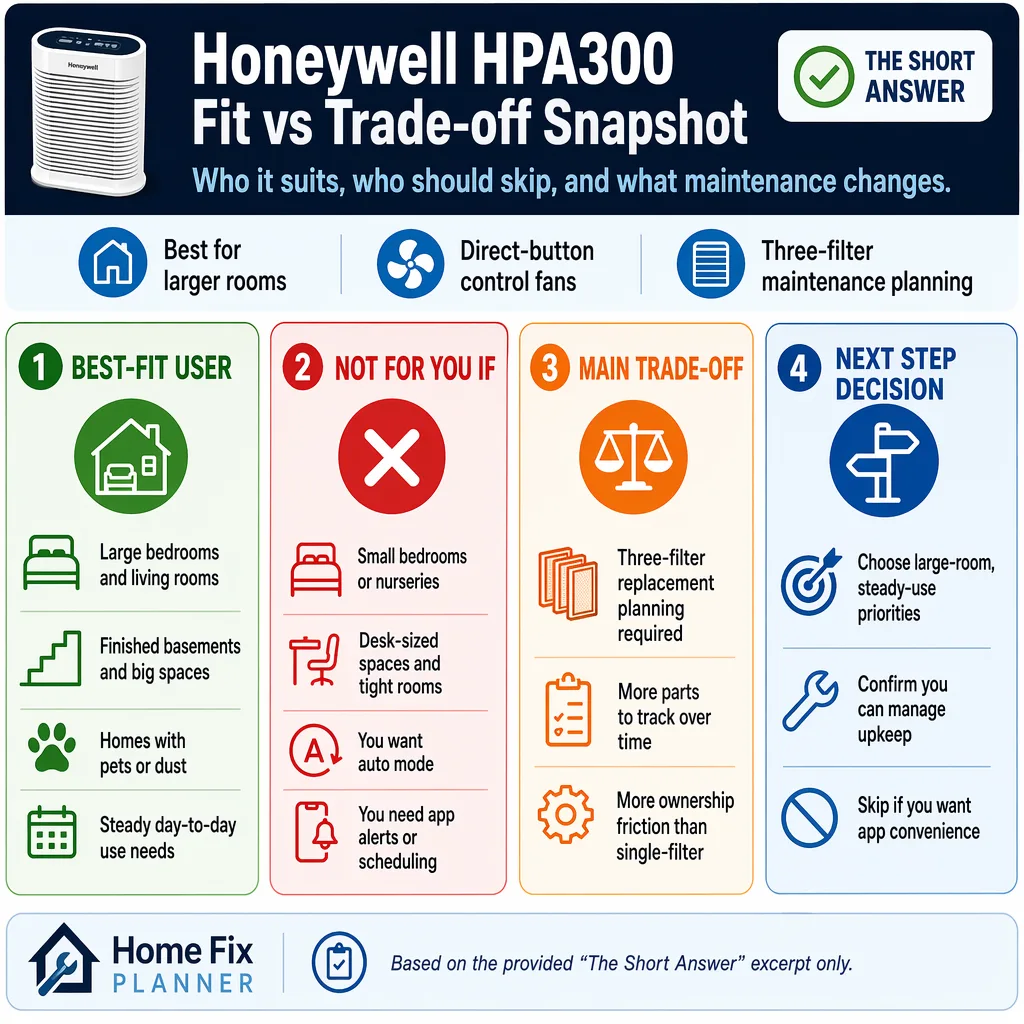
This model makes sense for homeowners who want a no-drama purifier that handles a bigger room without turning into a tech project. The trade-off is maintenance, because the three-filter setup adds replacement planning, extra parts to track, and more ownership friction than a simpler single-filter unit.
Best for
- Large bedrooms, living rooms, and finished basements
- Homes with pets, dust, or steady day-to-day use
- Buyers who prefer direct buttons over app-driven controls
Not for
- Small bedrooms, nurseries, and desk-sized spaces
- Shoppers who want auto mode, app alerts, or scheduling
- Anyone who wants the lightest possible filter upkeep
Fast read The HPA300 wins on plain utility. It loses ground when convenience means fewer filters, fewer parts, and less floor-space demand.
What This Analysis Is Based On
This is a buyer-fit analysis built around published product details, the replacement-filter ecosystem, and the way a purifier affects a room after the box is opened. The important questions are not flashy ones. They are whether the unit fits the room, whether the controls stay simple, and whether the upkeep stays manageable after the first filter change.
That is the part most product pages gloss over. A purifier is not just a box with airflow. It is a recurring ownership task, and the filter routine decides whether it feels easy or annoying by month two.
The Lowdown on the Honeywell HPA300
The HPA300 is built around straightforward filtration rather than software. That is the point. It belongs to the crowd of appliances that stay on because they are easy to understand, not because they are packed with extras.
Matte, black, and discreet
The matte black finish helps the unit blend into a room better than a bright white plastic tower. That matters in a living room, den, or main-floor space where the purifier sits in plain sight. It does not erase the footprint, though, and a discreet color does nothing to change the need for clear intake space around the cabinet.
The appearance is a real plus for buyers who hate visual clutter. The trade-off is that the unit still behaves like a floor appliance, not a shelf accessory. It needs space, and it looks best when it gets that space.
Why have one filter when you can have three?
Most guides treat more filters as automatic value. That is wrong. More filters mean more replacement pieces, more tracking, and more storage space for spares. The HPA300 gives you a cleaner internal layout, but the ownership routine gets heavier outside the machine.
That trade-off matters in a way a spec sheet does not show. A buyer with a closet full of seasonal gear feels the filter burden less than a buyer with one crowded hall closet. The practical question is simple: do three filters feel like useful coverage, or do they feel like three things to keep buying?
Simple operation
Simple operation is the HPA300’s strongest everyday advantage. One look at the control setup tells the story. There is less to learn, less to mis-set, and less reason to open a phone app just to turn on a purifier.
That simplicity helps in shared rooms where more than one person uses the appliance. It also helps when the goal is routine, not experimentation. The downside is just as clear, no smart automation, no app alerts, and no air-quality readout to manage the machine for you.
Where It Makes Sense
The HPA300 fits rooms that stay lived-in, not decorative. It makes the most sense where air moves through a space all day and the purifier needs to keep up with people, pets, and regular dust.
| Room or scenario | Fit | Why it works | Watch-out |
|---|---|---|---|
| Large primary bedroom | Good | Simple controls and stronger-room coverage | It still takes floor space and filter upkeep |
| Living room with pets | Good | Built for steady daily use in a busy room | Replacement filters become part of the budget |
| Finished basement or rec room | Good | Useful where dust and stale air build up | Not a whole-home solution |
| Small bedroom or nursery | Poor | Bigger than the job requires | A compact model fits better |
| Open floor plan | Mixed | Helpful in the room people use most | One purifier does not clean every zone |
Best-fit use cases
- A main room that stays occupied daily
- A home with pet hair, dander, or regular dust
- A buyer who wants simple operation over smart features
Bad-fit use cases
- A tiny room with limited floor space
- A bedtime setup where quiet matters most
- A buyer who wants the lowest possible filter burden
Where the Claims Need Context
The main trap is buying on output alone. Output matters, but upkeep decides whether the purifier stays in use. A model with more filter parts can look efficient on paper and still feel annoying once replacement time arrives.
Maintenance burden callout The HPA300 asks for more than a plug-and-play mindset. You need to stock the right filters, store them somewhere dry, and budget for recurring replacement purchases. That is part of the real price.
Monthly upkeep estimate
| Use pattern | Upkeep load | What it means |
|---|---|---|
| Light use in a clean room | Low | Filter shopping stays limited |
| Daily use in a bedroom or living room | Medium | Replacements become a regular task |
| Pets, smoke, heavy cooking, or a dusty basement | High | Filter spending and cleanup rise fast |
The number that matters is the replacement cycle, not the purchase-day sticker. Check the filter pack price before you buy, because a purifier with simple controls can still become a recurring expense if it works hard every day.
One more limit matters here. This is not a smart purifier. If the room needs automatic fan changes or app control, the HPA300 is the wrong fit. Buy for simplicity, not for software.
Proof Points to Check for Honeywell Air Purifier
The smartest way to buy this model is to verify the parts and listing details before checkout, especially if the unit is open-box or used.
- Confirm the exact HPA300 model name, not a lookalike with a similar shell.
- Check whether the replacement filters are included or sold separately.
- Look for the exact filter part references in the listing so future replacements stay simple.
- Inspect photos for dust, smoke residue, yellowing plastic, or damaged intake grilles.
- Make sure the seller shows the control panel clearly, not just the front angle.
- Check the room plan before buying, because the unit needs open space around it.
A mainstream Honeywell purifier has a real secondhand advantage. Replacement filters and parts are easier to source than they are for obscure brands. That advantage disappears fast if the used unit looks rough or the seller cannot prove the exact version.
How It Compares With Alternatives
The HPA300 beats a smaller Honeywell purifier when the room is large enough to justify the extra coverage. It loses to that cheaper, more compact option when the room is a bedroom, office, or nursery and floor space matters more than reach.
Pick the HPA300 if the room is big, the use is steady, and the buyer wants one appliance that stays simple. Pick a smaller purifier if the main goal is lower upkeep, tighter placement, and less visual bulk. That is the cheaper path for a small room, but it gives up the broad-room comfort that makes the HPA300 appealing.
A smart purifier from another brand belongs on the shortlist only when automation matters more than simplicity. If app control, scheduling, and air-quality alerts drive the purchase, choose that route. If the priority is a plain, dependable purifier that anyone in the house can run, the HPA300 stays stronger.
Decision Checklist
Use this as the final yes or no screen.
- The purifier sits in a large or open room.
- You want direct controls, not an app.
- You accept recurring filter replacements.
- You have floor space and clear intake room.
- You plan to use it every day, not just occasionally.
- You do not need the quietest bedtime appliance on the market.
- You do not want to manage a more complex filter ecosystem.
If three or fewer of those land as a clear yes, a smaller purifier fits better. If most of them land as yes, the HPA300 earns its spot.
Bottom Line
Our verdict
Buy the HPA300 if the room is large, the use is steady, and simple operation beats smart features. Skip it if quiet bedtime use, a compact footprint, or the lightest maintenance routine sits at the top of the list.
This model succeeds because it keeps the decision simple. It removes air-cleaning friction inside the house, then adds a real maintenance commitment outside the house. That is a fair trade for the right room, and a bad trade for the wrong one.
Frequently Asked Questions
Is the Honeywell HPA300 good for pet homes?
Yes. It fits pet homes that need steady filtration in a larger room. The trade-off is filter upkeep, which rises faster in a pet-heavy house than in a low-traffic room.
Does the HPA300 need smart features to be useful?
No. The appeal is the opposite, simple controls and fewer things to set up. If scheduling, app alerts, or automatic fan changes matter, a smart purifier belongs on the shortlist instead.
What should a buyer check on a used HPA300?
Check the exact model label, the intake grilles, the condition of the housing, and the availability of replacement filters. A unit with heavy smoke odor or clogged dust buildup loses the convenience advantage fast.
Is the HPA300 too much for a bedroom?
For a small bedroom, yes. A compact purifier fits better and takes less space. For a large primary bedroom, the HPA300 makes sense if the room layout needs stronger coverage.
How important is the three-filter design?
It matters a lot. The three-filter setup is part of the performance story, but it also raises the ownership burden. Buyers who want fewer replacement parts should choose a simpler purifier.
See Also
If you are weighing this model, also compare it with Honeywell Designer Series Humidifier Review: Who It's Best For, and How to Choose the Right Fit, Honeywell 30 Pint Dehumidifier Review: Who It's Best for, and Dewalt 6-Gallon Shop Vac Review: What to Know Before You Buy.
For broader context before you decide, Fiberglass vs. Aluminum Ladders: Costs, Safety, and Maintenance (2026 Comparison Guide) and Klein Tools ET310 Review: A No-Nonsense Circuit Breaker Finder help round out the trade-offs.