A hammer drill is a sensible buy for homeowners who need one drill that handles wood, metal, and occasional brick or block. That answer changes fast if concrete drilling is frequent, because a rotary hammer handles that work with less strain. It also changes if the tool only sees cabinet installs, drywall anchors, and light fastening, because a drill/driver stays lighter, cleaner, and easier to store. This is the best-overall lane for mixed repair work, not the best answer for every garage.
Best fit: occasional masonry, one-tool storage, and mixed household repairs.
Watch out for: more noise, more dust, more vibration, and a real cleanup routine after use.
Quick Buyer-Fit Read
A hammer drill makes the most sense when the house keeps asking for mixed-material jobs. It handles light masonry without forcing a separate masonry-only tool into the closet, and it still behaves like a normal drill for a lot of everyday work. That convenience comes with a trade-off, though, because the hammer action adds noise, dust, and a little more annoyance every time the tool comes back off the shelf.
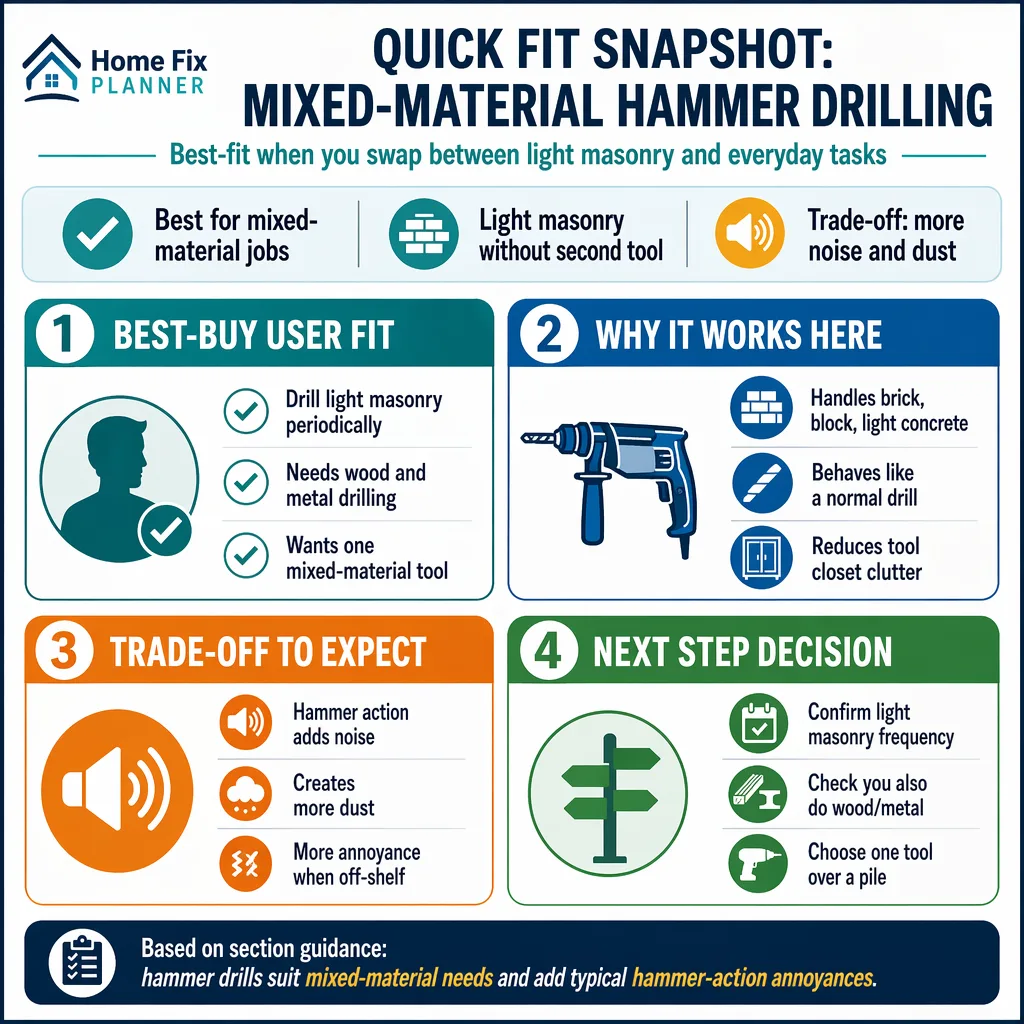
Best-fit scenario You need to drill brick, block, or light concrete a few times a year, you still want a drill for wood and metal, and you want one tool to cover both jobs without building a bigger tool pile.
How We Framed the Decision
This analysis centers on fit, not headline power. The right question is whether a hammer drill solves the jobs in front of the house without creating extra storage clutter, cleanup work, or accessory hunting.
Four things matter most:
- Material mix: brick, block, and light concrete justify a hammer drill. Wood, metal, and drywall alone do not.
- Frequency: occasional masonry use fits this tool. Weekly concrete drilling pushes the job toward a rotary hammer.
- Storage friction: a hammer drill earns its spot only if the case, bits, and accessories have a home.
- Accessory ecosystem: if the tool is cordless, the battery platform matters as much as the drill body because a lone battery line adds shelf clutter fast.
That lens matters because a tool that lives awkwardly on a shelf gets used less, even when it performs fine on paper. A hammer drill that is easy to grab, clean, and put away gets chosen more often than one that feels like a mini construction project before the first hole is drilled.
Where It Helps Most
A hammer drill fits best in the middle ground between basic household drilling and heavier masonry work. It belongs in a homeowner setup where brick steps, patio hardware, basement block, or masonry anchors show up now and then.
Strong use cases
- Hanging shelves or brackets into brick or block
- Mounting railings, fixtures, or hardware where masonry anchors are part of the job
- Drilling light concrete holes around the home
- Handling mixed repairs where the same tool also works on wood and metal
The advantage is obvious once those jobs start stacking up. One tool covers more of the house, and that keeps the tool budget and storage footprint under control. The drawback is just as clear: this is not the cleanest, quietest, or lightest path for simple drilling tasks, and it does nothing to remove the dust that masonry work creates.
A good hammer drill earns its keep by replacing a second purchase. If the same toolbox still needs a separate heavy-duty masonry tool, the space savings disappear.
The Main Limits
The biggest limit is category mismatch. A hammer drill handles light masonry, but a rotary hammer owns dense concrete and repeated anchor work. Most shoppers get that backward and buy too much tool for occasional jobs or too little tool for serious masonry.
Most guides recommend buying the biggest hammer drill available. That is wrong for homeowner use. Bigger size adds weight, noise, and shelf clutter, but it does not turn the tool into the right choice for heavy concrete.
Cleanup is the other hidden cost. Masonry dust does not stay on the floor. It works into the chuck, the vents, the case, and any loose bits sitting nearby. If the tool gets tossed into a drawer with no bit box or handle space, it turns into a messy extra object instead of a reliable repair tool.
Before buying, verify the details that shape ownership friction:
- Corded or cordless: cordless adds battery management. Corded adds less charging hassle and fewer extra parts.
- Chuck and bit compatibility: the tool has to match the bits you already plan to buy.
- Included accessories: a side handle, depth stop, and case matter more than decorative extras.
- What lives in the case: if the tool ships bare, the accessory pile grows fast and storage gets worse.
Accessory cost matters here, too. Masonry bits wear down faster than first-time buyers expect, and that recurring spend belongs in the decision. A hammer drill body with no plan for bits, anchors, and storage becomes a half-finished setup.
The First Filter for Hammer Drill
The first filter is workload, not brand, not finish, and not the strongest-sounding marketing line. If masonry shows up as an interruption, a hammer drill belongs on the shortlist. If masonry shows up as a routine, a rotary hammer belongs ahead of it.
Think in three lanes:
- Occasional masonry, mixed household repairs: hammer drill
- Frequent concrete or dense block: rotary hammer
- Wood, drywall, and metal only: drill/driver
That filter keeps buyers from overbuying. It also keeps storage cleaner, because the right tool category reduces the chance of buying a second system that lives in the garage and never earns space. For weekly users, the accessory ecosystem matters more, because spare bits, dust cleanup gear, and, on cordless models, battery platform choices become part of the real cost of ownership.
This is where convenience wins or loses. A hammer drill fits better when it has a clear job and a clear home. It frustrates fast when it becomes the catch-all tool for jobs that belong elsewhere.
What to Compare It Against
The cleanest comparison is a standard drill/driver. The stronger comparison is a rotary hammer. Those two alternatives sharpen the decision more than any spec sheet.
| Alternative | Better for | Why it wins | Where the hammer drill loses |
|---|---|---|---|
| Drill/driver | Wood, metal, drywall, general household fastening | Lighter, quieter, easier to store, less cleanup | Loses when brick, block, or concrete enters the job list |
| Rotary hammer | Frequent concrete, dense masonry, larger anchor work | Handles hard materials with less strain and less fight | Too specialized and bulky for general household drilling |
Pick a drill/driver if your projects stay inside ordinary home repair and you want the simplest tool to keep clean. Pick a rotary hammer if concrete work happens often enough to justify a more specialized machine. Pick a hammer drill when both worlds live in the same house and you want one tool that covers the mix without adding a second category to the shelf.
Buyer-Fit Checklist
Use this as the last check before buying.
| Green light | Red flag |
|---|---|
| Brick, block, or concrete appears in your project list | Most of your work stays in wood, drywall, or metal |
| You want one drill for mixed household repairs | You want the lightest, cleanest grab-and-go setup |
| You have a place for the tool, bits, and case | Loose accessories already create clutter |
| You accept dust and noise as part of masonry work | You want the quietest, simplest maintenance routine |
| You know this is not a rotary hammer | You expect heavy concrete performance |
If two or more red flags hit, a drill/driver or rotary hammer serves better. That is the whole point of the checklist, to keep the wrong tool from stealing shelf space and budget.
The Practical Verdict
A hammer drill is worth buying for homeowners who need occasional masonry capability and still want a general-purpose drill in the same package. It is the smart middle-ground choice for shelves, brackets, anchors, and light concrete work around the house.
Skip it if concrete drilling is your main job, because a rotary hammer handles that workload better. Skip it if masonry barely enters your projects, because a drill/driver gives you less clutter, less cleanup, and easier storage. The clear recommendation is simple: buy the hammer drill when mixed repairs are real, not hypothetical.
Frequently Asked Questions
Is a hammer drill enough for concrete?
A hammer drill is enough for light concrete holes and basic masonry anchors. Repeated drilling, larger holes, and dense slabs belong to a rotary hammer.
Do I need a hammer drill if I already own a drill/driver?
Yes, if brick, block, or concrete shows up in your home projects. No, if your work stays in wood, metal, and drywall, because the extra tool adds storage and cleanup burden without paying off.
What should I check before buying one?
Check whether it is corded or cordless, whether the case and side handle are included, and whether the bit setup matches the jobs you plan to do. Those details shape day-to-day ownership more than a marketing label does.
What creates the biggest ownership hassle?
Dust, bit storage, and accessory clutter create the biggest hassle. Wiping the tool down, keeping bits in one case, and giving it a real shelf spot keeps the hammer drill useful instead of messy.
See Also
If you are weighing this model, also compare it with Maglite LED Flashlight Review: Brightness, Build, and Maintenance Costs, Ryobi Wet Tile Saw Review: Buyer Trade-Offs, Costs, and Maintenance Tips, and Kobalt Torque Wrench Review: What to Know Before You Buy.
For broader context before you decide, Shingle Roof vs. Metal Roof Cost: Which Costs More to Install in the Us? and Klein Tools ET310 Review: A No-Nonsense Circuit Breaker Finder help round out the trade-offs.