Buyer Fit at a Glance
Strong fit: standard drill bits, recurring repair work, a fixed bench or shelf, and a buyer who values repeatability over improvisation.
Weak fit: specialty bits, cramped storage, and occasional users who want the simplest possible ownership path.
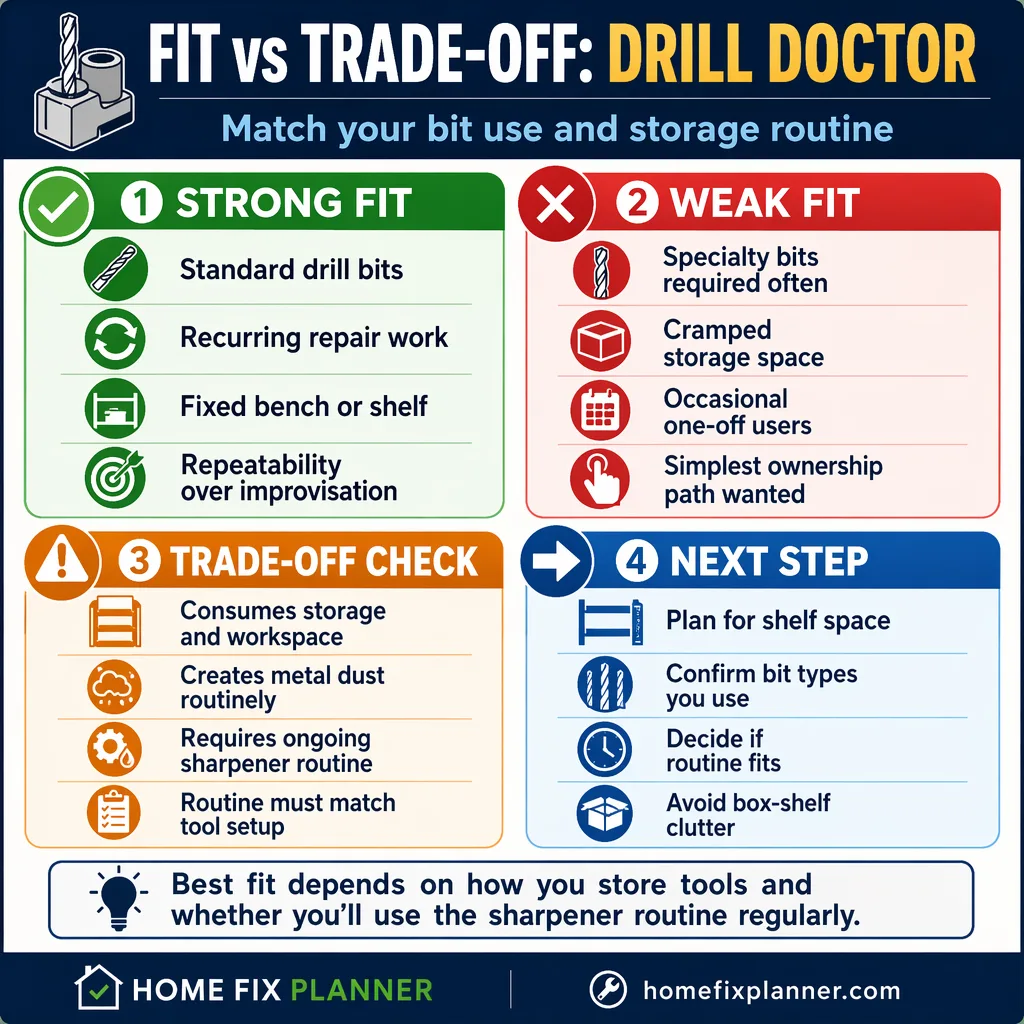
That trade-off matters more here than on many shop tools. A bit sharpener does not just restore an edge, it claims space, creates metal dust, and asks for a routine. If that routine fits the way the rest of your tools live, the value lands fast. If not, the box on the shelf becomes clutter with a motor in it.
What We Checked
This analysis weighs the things that decide ownership value, not just the headline promise. The big questions are bit compatibility, setup friction, cleanup burden, storage footprint, and the availability of replacement parts or wear items.
A sharpener that looks simple still loses ground if the chuck system is fussy or the accessory story is thin. That is the part many product pages skip. The machine has to fit the workbench, the bit drawer, and the cleanup habit, or it turns into another tool that gets moved aside instead of used.
Where It Makes Sense
Standard twist bits see regular reuse
Drill Doctor fits best where the same common sizes come back again and again, like cabinet work, general repairs, brackets, and shop fixes. If the bits are standard twist bits and you do not want to throw away a dull one every time it slows down, a dedicated sharpener keeps the workflow tidy.
The drawback is plain. Once you move into unusual geometries, very short bits, or damaged edges that are already beat up, the value drops sharply. This is not a universal rescue machine, and treating it like one creates disappointment.
You already keep a fixed work spot
A benchtop sharpener belongs in a place with an outlet, a shelf, and a surface that stays dedicated to tools. That setup keeps the process fast and prevents the unit from getting buried under random garage clutter.
The trade-off is space. If every square foot on the bench has another job, the tool starts competing with more useful gear. A sharpener that lives in a crowded corner gets used less, cleaned less, and resented more.
You sharpen enough to justify the habit
Weekly or monthly sharpening gives the tool a purpose. Light use does not. If a bit dulls only now and then, a fresh replacement or a grinder setup keeps the process simpler and avoids one more maintenance routine.
That is the hidden value test. A sharpening tool looks like a one-time purchase, but ownership includes dust cleanup, bit sorting, and keeping wear parts on hand. Buyers who already maintain a small shop routine get more from it than buyers who want a no-touch fix.
Where the Claims Need Context
Most guides treat drill bit sharpeners like universal tools. That is wrong. The first thing to verify is the exact bit family the model accepts, because standard twist bits, specialty bits, short bits, and damaged edges do not belong in the same lane.
Before buying, confirm these points:
- The smallest and largest bit sizes on the exact model.
- Which materials the unit accepts, such as standard steel or cobalt.
- Whether split-point or other point styles are part of the design.
- Whether replacement wheels, chucks, and other wear parts stay available.
- Whether the bit is worth saving in the first place. A chewed-up cutting lip belongs in the scrap pile.
A second issue gets ignored far too often, setup memory. A sharpener used once or twice a year loses some of its convenience because the buyer has to remember the routine again. That is why occasional users drift toward new bits instead of a tool that needs re-learning.
There is also a maintenance reality that manufacturers do not advertise loudly. Metal dust is not cosmetic. It spreads, settles, and turns a clean shelf into a gritty shelf if you do not clean up right away. For a tool built around convenience, that cleanup burden decides whether it feels helpful or annoying.
How It Compares With Alternatives
Drill Doctor wins on repeatability and a cleaner learning curve. A bench grinder with a drill-bit jig wins on flexibility if the grinder already lives on your bench. Replacing bits wins on simplicity for very light use.
| Option | Best fit | Main trade-off |
|---|---|---|
| Drill Doctor | Homeowners who sharpen standard bits often and want a dedicated machine | Needs storage, cleanup, and wear-part upkeep |
| Bench grinder with a drill-bit jig | Users who already own a grinder and want the most flexible shop setup | Steeper learning curve and more room for angle errors |
| Replace worn bits | Occasional users and clutter-averse garages | More waste and more ongoing replacement |
The deal-breaker is not sharpness alone, it is attention. Drill Doctor asks for a fixed spot and a simple routine. A grinder with a jig asks for skill. New bits ask for less effort but more waste. Weekly users should weigh replacement wheel and parts support heavily, because a tool with hard-to-find wear items turns into a dead end fast.
The First Filter for Drill Doctor
The first filter is storage, not sharpness. If the tool has no permanent home, the convenience disappears into clutter. Metal dust, loose bits, and a benchtop footprint demand a real cleanup routine, not a shrug and a shelf.
Use this as the first pass:
- Do you have a fixed bench, cabinet, or shelf spot near an outlet?
- Do you keep drill bits sorted by size and type?
- Do you clean grinding dust after each session?
- Do you want to keep wear parts and accessories on hand?
If the answer is no on two or more of those, the sharpener becomes another box that gets moved around the garage. That is the wrong ownership story for a tool built on convenience. The best Drill Doctor setup is orderly before the purchase even happens.
Decision Checklist
- You sharpen standard twist bits several times a month.
- You have a fixed spot for a benchtop tool.
- You want repeatability more than the lowest-effort replacement habit.
- You are willing to wipe down the machine and manage dust.
- You verified the exact model’s bit-size and material compatibility.
Four yes answers point to a good fit. Two or fewer point to a skip. In that case, a bench grinder with a jig or a simple replacement-bit routine stays cleaner and easier to live with.
Final Verdict
Buy Drill Doctor if your workshop already has a place for it, you sharpen standard bits often, and you want a repeatable edge without learning freehand grinding. Skip it if you only touch up bits once in a while, rely on specialty shapes, or dislike tools that bring cleanup and consumable upkeep with them.
Best buy for: homeowners with recurring drill-bit use and a dedicated bench spot.
Best skip for: occasional users and cluttered garages.
This is a maintenance tool disguised as a convenience tool. It pays off when the rest of your shop is organized enough to support it. If that setup does not exist, the cleaner move is to replace dull bits or use a grinder-and-jig path only when the project justifies it.
FAQ
What kinds of bits does Drill Doctor fit best?
Standard twist bits are the sweet spot. Confirm the exact model’s size and material limits before buying, because specialty bits and odd shapes sit outside the core use case.
Is Drill Doctor better than buying new bits every time one dulls?
It beats new bits when you sharpen often enough to use it regularly. It loses when you only dull a few bits a year, because the storage, cleanup, and setup routine outweigh the convenience.
Does it need a dedicated place in the garage or workshop?
Yes. A fixed shelf or bench spot keeps the tool useful. A shared clutter zone turns the sharpener into another item that gets moved instead of used.
What should I verify before buying?
Verify bit size range, material compatibility, replacement parts, and whether the exact model handles the drill bits you own. Do not assume one Drill Doctor setup covers every bit in the drawer.
Is a bench grinder with a jig a better choice?
A bench grinder with a jig fits buyers who already own a grinder and want maximum flexibility. It does not fit buyers who want an easier setup, cleaner repeatability, and less time spent dialing in the angle.
See Also
If you are weighing this model, also compare it with Maglite LED Flashlight Review: Brightness, Build, and Maintenance Costs, Ryobi Wet Tile Saw Review: Buyer Trade-Offs, Costs, and Maintenance Tips, and Kobalt Torque Wrench Review: What to Know Before You Buy.
For broader context before you decide, Shingle Roof vs. Metal Roof Cost: Which Costs More to Install in the Us? and Klein Tools ET310 Review: A No-Nonsense Circuit Breaker Finder help round out the trade-offs.