Yes, ryobi sliding miter saw makes sense for homeowners who want one saw that handles trim, shelving, and occasional framing without jumping to a contractor-grade price tier. The decision changes fast if the saw has to live in a cramped garage, get packed away after every cut, or sit unused for months at a time. Sliding miter saws buy flexibility, but they also charge a space and cleanup tax.
Quick Buyer-Fit Read
Best-fit scenario: A homeowner with a dedicated bench, garage corner, or rolling stand who cuts baseboard, casing, shelf stock, or mixed lumber on a regular weekend schedule.
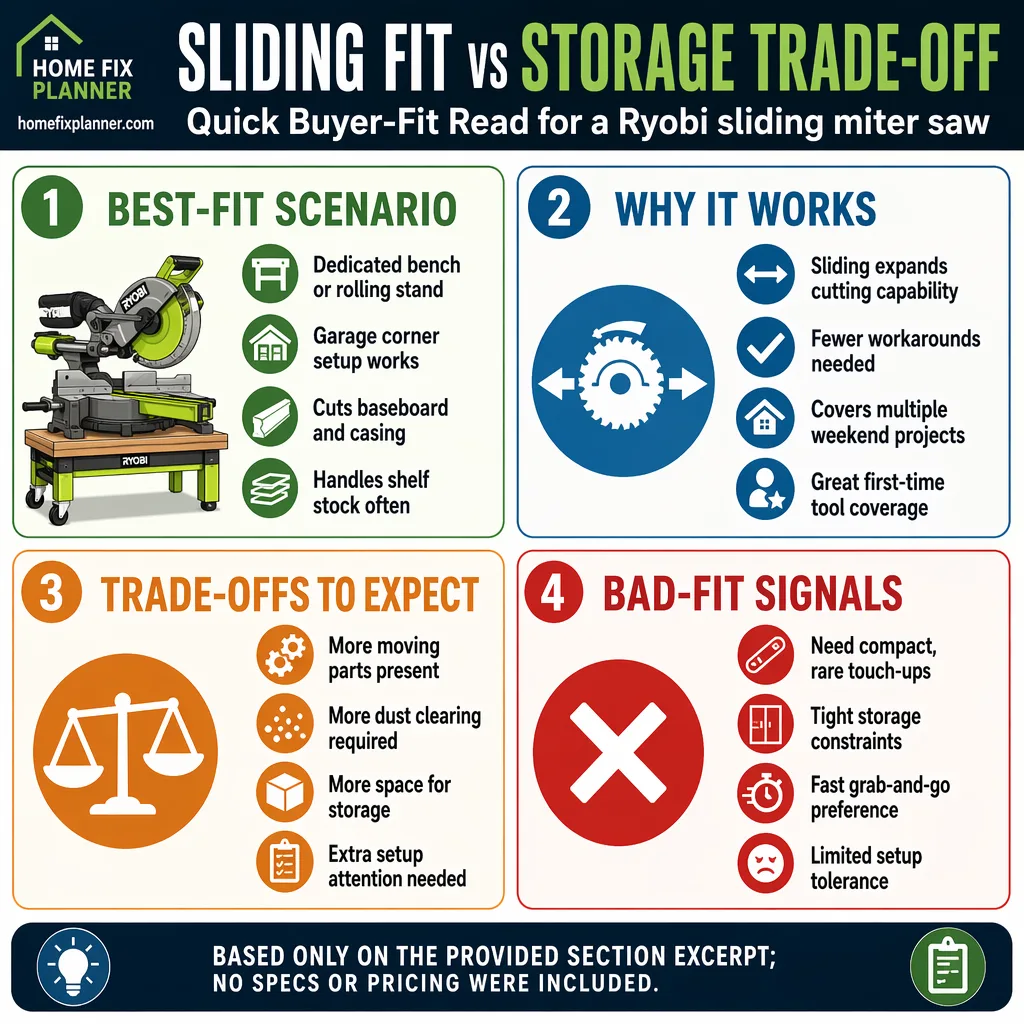
Bad fit scenario: A buyer who needs a compact saw for rare touch-ups, tight storage, or fast grab-and-go jobs.
Why it works: The sliding format expands what one saw handles without forcing workarounds. That matters more than headline branding for first-time buyers who want one tool to cover several projects.
What the trade-off looks like: More moving parts means more dust to clear, more space to store, and more attention to setup. The convenience is real, but it does not come free.
Best-fit box
Buy this if: you value cut range, plan to use it often, and have a place to keep it assembled or near-assembled.
Skip it if: storage is tight, cleanup annoys you, or your cuts stay small enough for a simpler saw.
How We Framed the Decision
This analysis centers on buyer fit, not showroom shine. The real questions are how much floor space the saw eats, how much dust and resin collect around the rails, and whether the sliding design earns its keep after the first project ends.
A saw like this wins when it reduces workarounds. It loses when the owner spends more time clearing off the bench and rechecking alignment than actually cutting. That ownership friction matters more than a glossy feature list, especially for a first-time buyer who wants predictable upkeep and a tool that stays useful.
The decision also turns on weekly use. A saw that gets pulled out every weekend justifies a larger footprint better than one used twice a year. Secondhand shopping changes the math too, because a used sliding saw hides wear in places photos never show, especially around the rails and guard area.
Where It Makes Sense
Pro vs. DIY tools
Ryobi sits in the mainstream DIY lane, and that is the right lane for a lot of homeowners. The value is practical, not bragging rights. You get a sliding saw that suits a home shop, while a heavier pro-grade saw suits daily jobsite punishment and constant transport.
That difference matters. A pro-grade unit earns its keep through repeated abuse and nonstop deployment. A home-shop Ryobi earns its keep through convenience, lighter commitment, and enough range to handle more than one project type.
| Project type | Fit with a Ryobi sliding miter saw | Why it works or misses |
|---|---|---|
| Baseboard and casing | Strong fit | Sliding action helps with wider trim and repeated cuts, which saves time on finish work. |
| Shelving and built-ins | Strong fit | The extra reach helps with larger boards and reduces awkward workarounds. |
| Occasional framing | Good fit | One saw handles a wider mix of cut sizes, but the bulk still matters when storage is limited. |
| Rare touch-ups only | Poor fit | The footprint and cleanup burden outweigh the convenience for tiny, infrequent jobs. |
The main ownership reality shows up after the project is done. Sliding saws collect dust in more places, and that cleanup routine becomes part of the tool’s real cost. Buyers who enjoy a tidy workspace notice this fast. Buyers who ignore maintenance end up with a saw that feels rougher every time it comes out.
Where the Claims Need Context
The headline promise on a sliding saw looks simple, but the buying details live in the small stuff. Sightline, fence behavior, and guard movement decide whether the tool feels clean and controlled or fussy and slow.
Line of sight
Most guides obsess over raw cutting power. That is wrong for home use. Line of sight matters more because it decides how fast you line up trim, how often you cut to the wrong side of a pencil mark, and how much time disappears into rechecking each setup.
A crowded sightline adds friction to every cut. A cleaner view of the blade-to-mark relationship turns a sliding saw into a precision helper instead of a guessing game. For first-time buyers, that difference shows up immediately on finish work where even a small mistake means another trip for more material.
The fence
The fence controls repeatability, and repeatability saves money. A solid fence keeps boards square, supports better setup habits, and reduces the need to babysit every cut. Most guides treat the fence like background hardware. That is the wrong call because fence quality changes whether the saw feels trustworthy.
If the fence feels flimsy, the saw stops being a time saver. It becomes a constant square-check exercise. That is a bad fit for homeowners who want cleaner work with less fuss.
Blade guard
Blade guard behavior affects daily use more than most product pages admit. A guard that moves smoothly keeps the saw easy to use for repeated cuts. A sticky or awkward guard slows the whole workflow, and buyers blame the blade when the guard is the real problem.
This is also where cleanup and maintenance show up hard. Dust gathers around the guard, rails, and pivot points, so a quick wipe-down after each session pays off. Skip that habit and the saw starts feeling less refined long before the blade is actually dull.
Where Ryobi Sliding Miter Saw Is Worth Paying For
The sliding format is worth paying for when it replaces workarounds, not when it simply looks more advanced. That line is sharp. If the saw handles wide trim, shelving, and occasional framing without forcing a second tool purchase, the extra footprint earns its space.
It loses value when the saw sits in storage more than it cuts. In that case, the larger chassis becomes a penalty every time you move it, clear it, or set it back up. A non-sliding saw feels less dramatic, but it also asks less from the garage.
Ownership cost notes
The purchase price is only the starting point. A sharp blade, dust collection add-ons, and some kind of stand or dedicated surface shape the real cost of owning a sliding saw. Those extras matter because the saw’s size makes a sloppy setup more annoying than it would be on a smaller tool.
Replacement blades and dust-management pieces are not optional if the saw sees regular use. That is especially true for homeowners who cut MDF, trim, or material that loads up the blade fast. A clean saw cuts better and stores better. A neglected one turns every project into a cleanup session first.
How It Compares With Alternatives
A simpler non-sliding compound miter saw is the cleanest alternative. It fits smaller shops, stores easier, and cuts down on setup clutter. It loses on reach and flexibility, which matters the moment wider stock enters the picture.
A heavier pro-grade sliding saw sits at the other end. That option delivers more rugged jobsite confidence, but it also brings more weight, more cost, and more storage hassle. For a homeowner, that extra muscle makes sense only when the saw sees near-daily use or serious renovation volume.
Short version:
- Choose the Ryobi sliding saw for broader cut range, regular weekend work, and a home shop that has room to breathe.
- Choose a non-sliding saw for compact storage, lighter cleanup, and simple trim jobs.
- Move up to a pro-grade sliding saw only when daily use and transport abuse justify the added bulk.
One common misconception needs correcting here: more saw is not automatically better. Many first-time buyers overbuy the largest sliding model they can find, then hate the storage and cleanup burden. The smarter move is the smallest saw that covers the widest repeat job in the house.
Decision Checklist
Use this list before buying:
- You have a permanent or semi-permanent place to store the saw.
- Your projects include trim, shelving, or boards that benefit from sliding capacity.
- You are willing to clear dust and resin from the rails and guard area.
- You want one saw for recurring weekend work, not an occasional emergency tool.
- You plan to inspect the fence, blade guard, and sightline before checkout.
- You are ready for accessory costs like a better blade or dust-control setup.
Skip the Ryobi sliding miter saw if:
- The saw has to live on a shelf and disappear after each use.
- You cut small stock only.
- You want the lightest, simplest setup possible.
- You will not maintain it after each project.
If two or more of those skip points hit home, the simpler saw wins. Not because it does less, but because it fits your space and habits better.
Bottom Line
ryobi sliding miter saw is a smart buy for homeowners who want broader cutting flexibility and accept the cleanup and storage burden that comes with a sliding design. It fits garage workshops, recurring trim projects, and buyers who want one tool to stretch across several jobs.
Skip it if your space is tight or your projects stay small. A simpler non-sliding saw handles those jobs with less clutter, less setup, and less maintenance friction. The Ryobi earns its place when convenience and range matter more than compactness.
Frequently Asked Questions
Is a Ryobi sliding miter saw too much for basic trim work?
No. It fits basic trim work well, especially when the trim gets wider or the project includes repeated cuts. The downside is simple, it takes more room and asks for more cleanup than a smaller saw.
What should I check before buying one?
Check the fence, blade guard movement, sightline to the cut mark, and how easily the saw sits on your bench or stand. Also verify the included blade and dust-collection setup before you leave the store.
Does a sliding miter saw need more maintenance?
Yes. The rails, guard area, and moving parts collect dust and resin, so regular cleaning keeps the saw smooth and accurate. A neglected sliding saw feels clunky faster than a compact saw.
Is Ryobi the right choice for a first workshop?
Yes, for a homeowner workshop that wants versatility without contractor-grade weight. It is the wrong choice if the saw will live in a cramped space or get used only a few times a year.
What alternative fits better if I have limited storage?
A non-sliding compound miter saw fits better. It gives up some cutting range, but it stores easier, cleans up faster, and creates less ownership friction for light use.
See Also
If you are weighing this model, also compare it with Maglite LED Flashlight Review: Brightness, Build, and Maintenance Costs, Ryobi Wet Tile Saw Review: Buyer Trade-Offs, Costs, and Maintenance Tips, and Hitachi Compound Miter Saw Review: What to Know Before You Buy.
For broader context before you decide, Flat Paint vs Satin Paint: Cleanup, Touch-Ups, and Durability and Klein Tools ET310 Review: A No-Nonsense Circuit Breaker Finder help round out the trade-offs.