The Husqvarna 435 Chainsaw is a sensible buy for homeowners who want a gas saw for cleanup, storm debris, and occasional firewood work, not for buyers who want the lightest, quietest, lowest-maintenance tool on the shelf. The answer changes fast if the saw will live mostly in a garage and start only a few times a year, because gas ownership brings fuel care, bar oil, chain sharpening, and storage cleanup. It also changes if your cutting stays limited to small branches, where a simpler electric saw leaves less mess and less friction. For first-time buyers who want more cut authority than a basic electric unit, the 435 belongs on the shortlist.
Quick Buyer-Fit Read
Best fit
- Homeowners who cut limbs, brush, and storm debris a few times a season
- Buyers who accept gas-saw upkeep in exchange for stronger cutting confidence
- People who want a mainstream brand with a broad parts and accessory ecosystem
- First-time buyers who want one saw to handle more than tiny yard cleanup
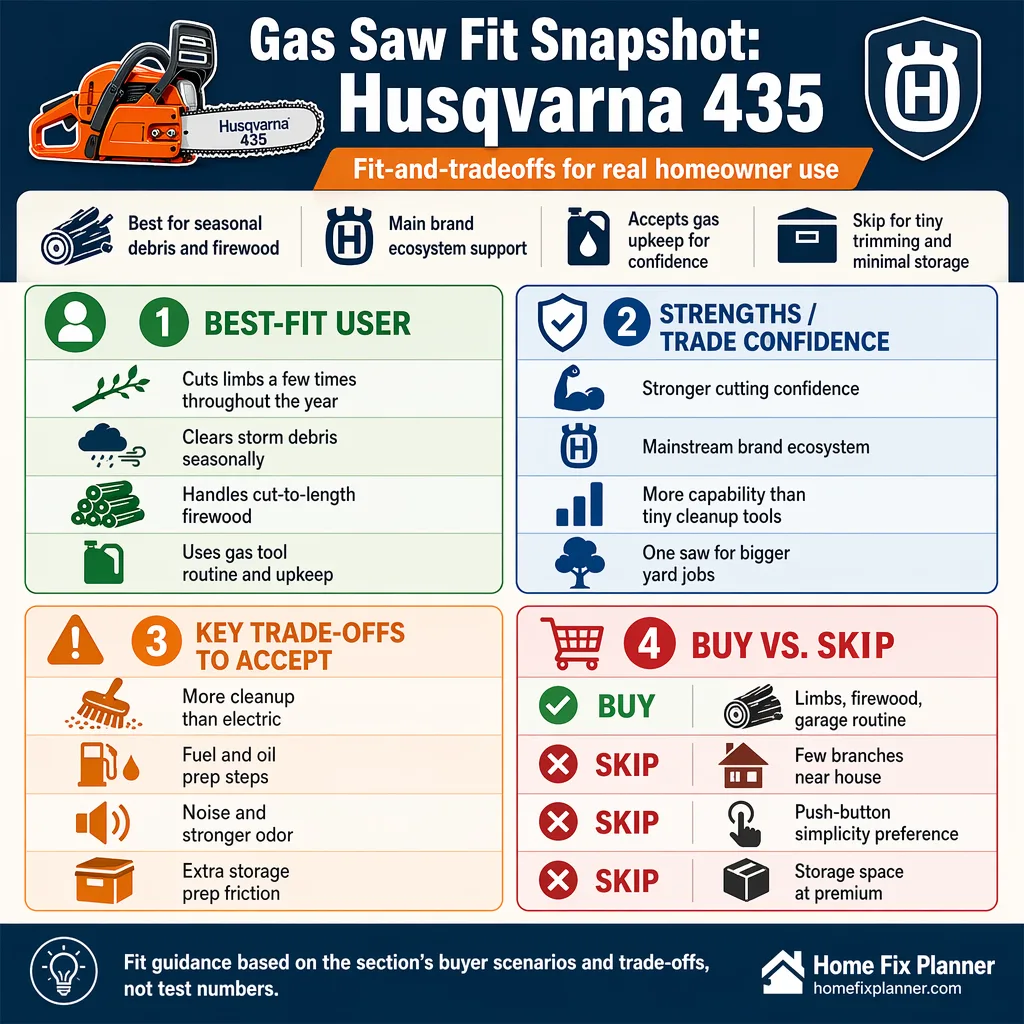
Main trade-offs
- More cleanup than battery or corded electric ownership
- More steps before and after use, especially fuel, oil, and storage prep
- More noise and more odor than an electric saw
- More total friction if the saw sits unused for long stretches
Best-fit scenario box
Buy this saw if your work looks like this: a yard with fallen limbs after bad weather, a stack of cut-to-length firewood, and a garage where a gas tool fits the routine.
Skip it if your work looks like this: trimming a few branches near the house, with storage space at a premium and a strong preference for push-button simplicity.
What We Checked
This analysis centers on the ownership decision, not a pretend practical comparison. The important questions are simple: how much cleanup the saw creates, how hard it is to keep ready, how it fits a homeowner’s job list, and whether the parts and bar-and-chain setup stay manageable after the first purchase.
| Decision factor | Why it matters for the 435 |
|---|---|
| Cleanup and storage | Gas saws leave more mess on the housing, bar, and shelf than electric tools |
| Starting routine | First-time buyers feel the difference between easy ownership and fuel-tool friction fast |
| Bar and chain support | Replacement parts shape downtime more than raw cutting talk does |
| Weekly use pattern | A saw that sees seasonal work has different value than one used every weekend |
| Parts ecosystem | Easy access to chains, bars, files, and covers lowers ownership pain |
That last point matters more than many product pages admit. A saw that cuts well but turns into a scavenger hunt for parts creates a bad second season. Mainstream brand support keeps the tool useful after the excitement fades and the chain needs attention.
Where It Makes Sense
The Husqvarna 435 fits homeowners who want a step above a small electric saw without jumping into a heavy-duty pro machine. It belongs in yards where cleanup jobs arrive in bursts, not every day. That makes it a practical choice for storm season, deadwood cleanup, and the occasional firewood stack.
Strong use cases
- Storm cleanup after limbs hit the ground
- Light to moderate firewood cutting
- Property maintenance where fuel-powered reach matters
- Buyers who already keep basic tools, oils, and files organized
Poor use cases
- Tiny branch trimming around landscaped beds
- Buyers who hate fuel smell, spark plugs, and air filter maintenance
- Garage storage situations where every tool must stay ultra-clean
- Casual users who want the simplest possible startup routine
Where Husqvarna 435 Chainsaw Is Worth Paying For
This is the section where the 435 earns its place over cheaper homeowner saws. The money makes sense when the saw has a real job, real storage, and real maintenance, not when it exists for a once-a-year branch trim. Paying for a more capable gas saw makes the most sense when downtime costs more than the upgrade.
A cheaper saw looks smart on the shelf and expensive the first time the chain dulls fast, the bar wear gets annoying, or the tool feels underpowered on thicker wood. The 435 solves that kind of frustration better than a bargain option that strains on heavier cleanup. That said, it does not buy comfort. Buyers still get gas-tool noise, fuel handling, and post-job wipe-downs.
A simpler alternative like a Husqvarna 120 Mark II makes more sense for smaller yards and lighter pruning. The 435 pays off when the wood gets heavier, the cleanup stack gets larger, and the buyer wants more reserve without stepping into a much larger saw class.
Where the Claims Need Context
Starting
Gas saw ownership begins before the cut. Starting prep, fuel management, and seasonal storage shape how pleasant the saw feels to own. Buyers who expect cordless convenience will feel disappointed fast, because the routine includes more steps and more attention.
That trade-off is not a flaw. It is the price of fuel-powered range and stronger job flexibility. For a homeowner who only opens the garage for occasional cleanup, the question is simple: does the added effort buy enough cutting confidence to justify the routine?
Power
Power matters most when the work stops looking tidy. Downed limbs, rough cuts, and mixed-size firewood push a small saw into slow territory. The 435 fits buyers who want more authority than a lightweight electric tool and fewer compromises when the wood is not cooperative.
The mistake many first-time buyers make is chasing raw power for small jobs. That backfires. More saw than the task demands brings more weight, more cleanup, and more storage friction without improving the day-to-day experience.
Handling and cleanup
Handling is not just balance in the hand. It is also what happens after the cut. Gas saws leave residue on the bar cover, the body, and the shelf where they sit, and that cleanup becomes part of the ownership bill.
Bar-and-chain choice matters here too. For typical homeowner use, a shorter, easier-to-manage bar setup beats a longer one unless your wood size justifies the extra reach. Do not oversize the bar just because longer sounds tougher. A longer setup changes balance, storage fit, and chain maintenance burden faster than it improves convenience.
Maintenance cost snapshot
| Ownership item | What it does | Buyer impact |
|---|---|---|
| Chain sharpening | Keeps cuts efficient and safer | Frequent attention item |
| Replacement chain | Restores cutting performance after wear | Small recurring cost that adds up if neglected |
| Bar | Guides the chain and wears over time | Important replacement part, not a one-time purchase |
| Bar oil | Lubricates the cutting system | Non-negotiable operating expense |
| Air filter and spark plug | Support reliable operation | Simple upkeep, big payoff in readiness |
| Fuel handling or stabilizer | Supports storage and restarting | The hidden cost of gas ownership |
That table is the real ownership story. The saw itself is only part of the budget. The routine parts and upkeep decide whether the tool feels smart or annoying after the first season.
How It Compares With Alternatives
| Option | Best for | Trade-off |
|---|---|---|
| Husqvarna 435 | Mixed homeowner cleanup, storm work, and modest firewood use | More cleanup and maintenance than electric |
| Husqvarna 120 Mark II | Smaller yards and lighter pruning jobs | Less reserve for thicker wood and bigger cleanup |
| Corded electric saw | Short jobs near an outlet and low-maintenance storage | Cord limits reach and storm-response freedom |
| Battery saw | Low-noise trimming and quick starts | Battery cost and runtime planning become part of the job |
The 435 stands out when the cut list is real and the saw gets used often enough to justify its upkeep. A corded electric saw fits the buyer who values low hassle over reach. A smaller gas saw like the 120 Mark II fits the buyer who cuts less wood and wants a lighter tool with less ownership burden.
Do not buy the 435 just because it sounds more serious. Buy it when the heavier jobs are part of your routine and the maintenance trade-off still feels fair.
Fit Checklist
Use this checklist as a blunt filter:
- You want a gas saw, not battery convenience.
- You cut more than small decorative branches.
- You accept fuel, bar oil, and chain care as part of ownership.
- You have a place to store the saw, bar cover, oil, and spare parts together.
- You want a mainstream brand that keeps replacement chains and accessories easy to source.
- You plan to maintain the chain instead of replacing the saw when it dulls.
If three or more statements ring true, the 435 fits the job. If fuel handling, noise, or cleanup already sound annoying, stop there and move to a simpler electric option.
See where the Husqvarna fits
Compare this gas-saw ownership routine with the full occasional home-use chainsaw shortlist , including cordless options that may be easier to store between infrequent jobs.
The Practical Verdict
Buy the Husqvarna 435 if you want one homeowner saw that handles cleanup with authority and you accept the maintenance that comes with gas power. Skip it if your work is light, your storage is tight, or you want the cleanest possible ownership experience.
The appeal is not luxury. It is useful capacity without jumping into a bigger saw class. That matters for homeowners who want a tool that stays relevant after the first storm, the first pile of limbs, and the first dull chain.
Frequently Asked Questions
Is the Husqvarna 435 a good first gas chainsaw?
Yes, for a homeowner who wants to learn gas-tool upkeep and cut more than light twigs. It is not the best first saw for someone who wants zero-fuss storage and instant startup, because gas ownership brings fuel care, chain maintenance, and more cleanup.
What bar length makes sense for typical homeowner use?
A shorter homeowner-friendly bar makes the most sense for most first-time buyers. It keeps the saw easier to balance, easier to store, and less tiring on the hands. Do not size up unless your cut list regularly includes larger wood that truly needs the extra reach.
What maintenance does this saw require?
Expect chain sharpening, bar oil refills, air filter care, spark plug checks, and fuel storage discipline. Those are normal gas-saw tasks, and they set the rhythm for long-term ownership more than the brand name does.
What should I compare it against?
Compare it against a smaller homeowner gas saw like the Husqvarna 120 Mark II if your jobs stay light, or a corded electric saw if your cutting stays near the garage and convenience matters more than reach. The 435 makes sense only when the extra gas-saw capability actually gets used.
Does the 435 make sense for storm cleanup?
Yes, if the cleanup involves downed limbs, rough cuts, and enough debris to justify a gas saw. It does not make sense for tiny trim jobs after a storm, because the cleanup and fuel routine outweigh the benefit.
See Also
If you are weighing this model, also compare it with Maglite LED Flashlight Review: Brightness, Build, and Maintenance Costs, Ryobi Wet Tile Saw Review: Buyer Trade-Offs, Costs, and Maintenance Tips, and Dewalt 6-Gallon Shop Vac Review: What to Know Before You Buy.
For broader context before you decide, Fiberglass vs. Aluminum Ladders: Costs, Safety, and Maintenance (2026 Comparison Guide) and Klein Tools ET310 Review: A No-Nonsense Circuit Breaker Finder help round out the trade-offs.