Yes, Kobalt XTR 24-volt 1/2-in Keyless Brushless Cordless Drill KXDD 1424A-03 makes sense for homeowners who want one cordless drill to handle recurring repairs and already plan to stay in Kobalt’s 24V battery system. The answer changes fast if you want the lightest drill in the cabinet or a bargain tool for rare, one-off tasks. It also changes if you prefer a brand that already powers your other tools, because the real cost sits in the platform, not just the drill body.
Quick Buyer-Fit Read
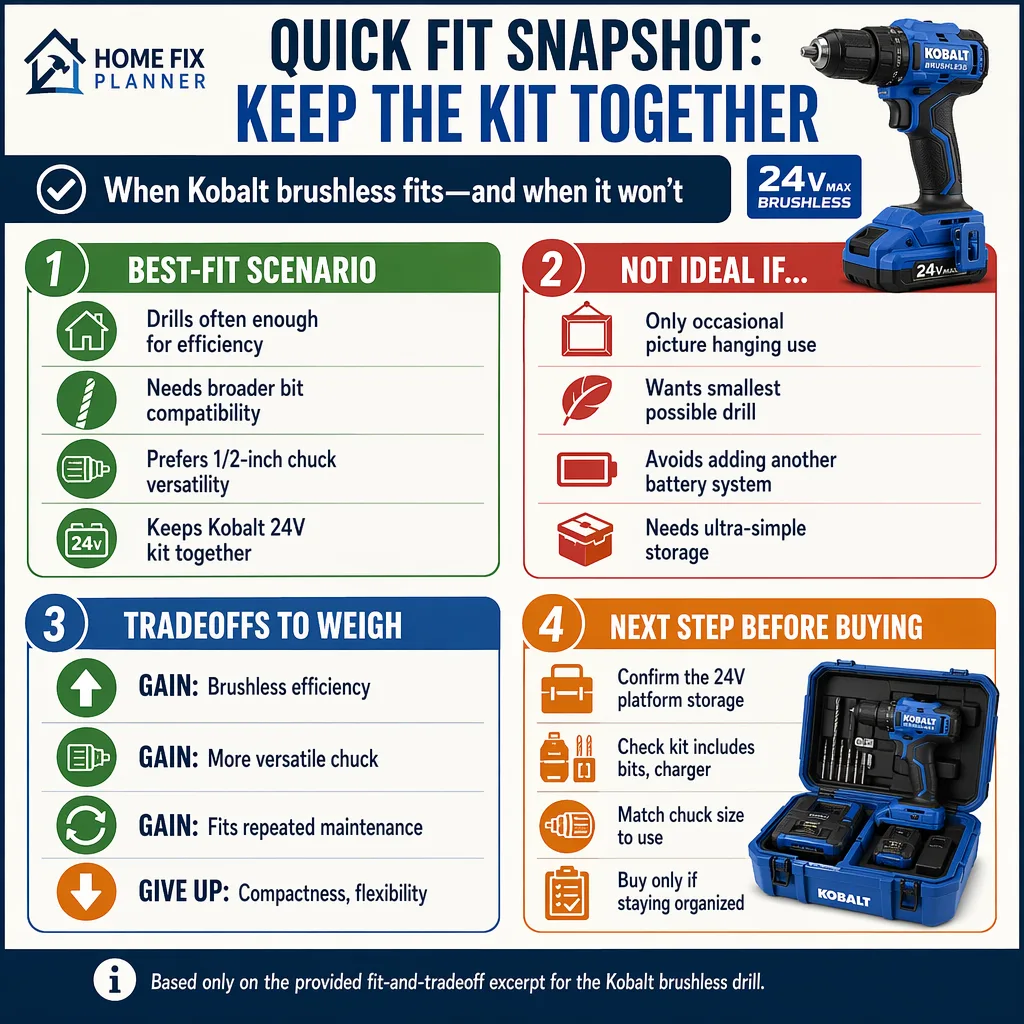
Best-fit scenario: A homeowner who drills often enough to care about motor efficiency, wants a 1/2-inch chuck for broader bit use, and will keep the drill with a Kobalt 24V battery, charger, and bit set in one place.
Not ideal for: A first-time buyer who only needs a tool for occasional picture hangings, a shopper who wants the smallest possible drill, or anyone trying to avoid another battery system on the shelf.
Ownership trade-off summary
- You get: brushless efficiency, a more versatile chuck, and a platform that suits repeated home maintenance.
- You give up: compactness, ecosystem flexibility, and some storage simplicity.
- You should care: because a cordless drill is only convenient when the battery, charger, and bits stay organized together.
The biggest misconception is simple. Most guides treat brushless as the whole story. That is wrong. For a first-time buyer, the battery platform and kit contents matter more than the motor label if the drill spends most of its life in a closet or garage bin.
Our Research-Based Analysis
This analysis translates the model’s core traits into homeowner value. The useful signals are the brushless motor, the 1/2-inch keyless chuck, and the 24V battery platform, not a parade of buzzwords.
Brushless matters because it removes a wear point that older brushed motors carry. That does not turn every job into a power event, but it does line up well with repeated use, especially for people who handle recurring repairs instead of once-a-season projects.
The 1/2-inch chuck matters for a different reason. It opens the door to a wider spread of common bits and accessories, and that is exactly what first-time buyers need when a weekend repair turns into pilot holes, driver bits, and mixed hardware. The trade-off is body size. A bigger chuck and a more serious platform usually land in a drill that feels less dainty than a compact 12V or 20V model.
The 24V format matters most for ownership friction. It points to a tool that belongs in a system, not in isolation. If you already own Kobalt 24V batteries, the value rises sharply. If you do not, the drill becomes a starting point for a battery family, which means another charger, another place to store packs, and another decision every time a battery ages out.
Where It Makes Sense
This drill fits weekly home maintenance better than casual drawer duty. It belongs with homeowners who fix loose hardware, mount shelves, assemble furniture with regularity, or swap between drilling and fastening on a steady basis.
| Project | Fit | Why it fits or misses |
|---|---|---|
| Cabinet hardware and shelf installs | Strong fit | The 1/2-inch chuck and brushless layout suit repeated drilling and screw driving. |
| Furniture assembly and light repairs | Good fit | Useful when the job moves between bits and fasteners, but the size is more than a basic compact tool. |
| Deck screws and outdoor trim work | Good fit | Works well for routine homeowner repairs, though battery management matters more on bigger jobs. |
| Concrete anchors and brick | Poor fit | A brushless drill is not the same thing as a hammer drill. |
The storage angle matters here. This drill makes the most sense when it has a home, a charger, and a battery that lives near the workbench or garage wall. A loose drill with no system behind it turns into clutter fast.
Where the Claims Need Context
Most guides blur brushless drills into one giant “better” bucket. That is wrong. Brushless improves the motor side of the equation, but it does not erase battery cost, charger clutter, or the need to choose the right job.
Most guides also treat any cordless drill as a universal solution. That is wrong too. This model handles drilling and fastening for homeowner work, but concrete and stubborn masonry need hammer action or a dedicated rotary hammer. Don’t buy a brushless label and assume it replaces the right tool for the substrate.
Battery ecosystem note
Kobalt’s 24V platform only pays off cleanly if you stay inside it. If your garage already runs another brand’s batteries, this drill adds a separate charger and separate storage footprint. If you already own Kobalt 24V packs, the same battery can make the whole setup feel far less annoying.
The real hidden cost is not the drill body. It is the battery system over time. Batteries age even when the tool sits, and replacement packs change the economics faster than a new drill shell does.
Drilling
The drilling side of this model looks strongest for the jobs homeowners actually repeat. Shelf brackets, door hardware, curtain rods, cabinet installs, and pilot holes in wood sit in its sweet spot. A 1/2-inch chuck helps here because it keeps accessory options broad and avoids the dead-end feel of tiny specialty tools.
That said, bigger capability brings a larger physical footprint. If the drill spends time above shoulder height, in tight pantry corners, or on ladder work, the extra bulk shows up quickly. Small chores do not need a big drill body, and a lighter compact model feels easier for those tasks.
What this means on the wall
A more serious drill matters when the work repeats. For one quick hole, any serviceable drill feels fine. For a Saturday of bracket installs, repeated pilot holes, and mixed fasteners, the extra platform strength starts to earn its space.
Battery Life
Battery life here is less about a single number and more about the ownership pattern. The bundle matters. A drill with one battery and charger serves light use, but a second battery turns the whole setup into something that feels ready instead of interrupted.
That is the part product pages skip. A single pack means the drill spends time waiting. A spare pack turns the charging routine into background noise. For homeowners who keep tools in a garage or utility closet, that difference changes whether the drill feels convenient or slightly fussy.
Brushless design helps efficiency, but it does not remove battery planning. If the battery sits in a hot garage, ages out, or gets misplaced, the drill loses its advantage fast. Keep the pack indoors when possible, and treat the charger as part of the tool, not an accessory you hope to find later.
Ownership reality
The battery is the maintenance item. The drill body is the easy part. Buyers who ignore that split end up with a good tool and a bad routine.
Convenience
This is where the Kobalt drill either feels smart or starts to feel bulky. A keyless chuck speeds bit changes, and cordless freedom removes cord management from the equation. That is the convenience story on paper.
The ownership story is messier. A drill is easy to wipe down, but the system around it is not. Battery, charger, bits, and storage all need a slot. If those pieces spread across a workbench, the convenience advantage disappears in clutter.
Cleanup and storage friction
Keep the drill in one bin or on one wall hook with its charger nearby. That simple setup matters more than a flashy motor label. Most homeowners do not need a premium drill cabinet, they need a repeatable place where the tool, pack, and charger always land.
The trade-off is simple. This model makes life easier during the job, but it asks for more organization after the job.
How It Compares With Alternatives
A lighter compact 20V brushless drill makes more sense for shoppers who want less bulk, especially for furniture assembly, shelf hanging, and overhead work. That kind of drill wins on comfort and storage, but it gives up some of the stronger platform feel that makes the Kobalt XTR appealing for repeated repairs.
A corded drill still belongs on some shortlists. It fits bench-only work, avoids battery aging, and never asks for a charger shelf. The downside is obvious, cords add cleanup friction and kill the grab-and-go feel that makes cordless tools useful in the first place.
Shortlist logic
- Choose the Kobalt if you want one cordless drill for recurring homeowner work and you are ready to stay with Kobalt 24V batteries.
- Choose a compact 20V drill if comfort, weight, and tight-space handling matter more than platform strength.
- Choose a corded drill if the tool lives at a bench and battery management feels like extra overhead.
Proof Points to Check for Kobalt Brushless Drill
Before buying, verify the exact bundle details. The drill body is only half the story.
- Confirm the model number matches KXDD 1424A-03.
- Check whether the listing is bare tool only or includes a battery and charger.
- Look for a hard case or soft bag, because storage footprint changes fast once the kit arrives.
- Make sure any existing Kobalt batteries you own match the 24V platform.
- If buying used or open-box, inspect the battery contacts, chuck condition, and included charger in the photos.
- Verify the return policy if the listing leaves out the battery or charger.
This section matters because a good drill body with missing support gear creates the wrong kind of ownership. You gain a tool and lose convenience.
Decision Checklist
Use this as the last pass before checkout.
- You already own Kobalt 24V batteries, or you plan to build that system.
- Your projects include recurring drilling or fastening, not just rare hanging tasks.
- You want a 1/2-inch keyless chuck for broader accessory use.
- You have a storage spot for the drill, charger, and battery.
- You accept that brushless helps the motor side, not masonry performance.
- You do not need the lightest possible drill for overhead or one-handed use.
Skip it if:
- You only need a drill a few times a year.
- You want the cheapest simple tool for picture hooks and light furniture work.
- You already have a different battery platform and do not want another charger.
- Your main jobs involve concrete or brick.
Our Verdict
Buy this drill if you want a serious homeowner tool and plan to use Kobalt 24V as a real platform, not a one-off purchase. The XTR brushless setup fits recurring home maintenance, gives you a versatile 1/2-inch chuck, and makes more sense when the battery, charger, and storage plan are already in place.
Pass if you want the lightest drill, the simplest setup, or the least amount of system commitment. A smaller compact drill fits casual users better, and a corded model fits bench work better.
For weekly repairs and a garage that stays organized, this Kobalt earns its shelf space. For rare use, the extra platform baggage outweighs the benefit.
FAQ
Is the Kobalt XTR drill a good first drill for a homeowner?
Yes. It fits a first-time buyer who wants one cordless drill for recurring repairs, shelf installs, and basic fastening, as long as the buyer is ready for the Kobalt 24V battery system.
Do you need Kobalt batteries to use this drill?
Yes. The drill belongs to Kobalt’s 24V platform, so the battery choice is part of the purchase, not an afterthought.
Is brushless worth it on a homeowner drill?
Yes, when the drill gets regular use. Brushless makes more sense for repeated work and a more serious ownership setup than for a tool that lives in a drawer.
Is this drill good for concrete or brick?
No. A standard brushless drill does not replace a hammer drill or rotary hammer for masonry work.
Should you buy the bare tool or a kit?
Buy the bare tool only if you already own Kobalt 24V batteries and a charger. Buy the kit if you are starting from zero, because the real convenience comes from having the full system ready to go.
See Also
If you are weighing this model, also compare it with Maglite LED Flashlight Review: Brightness, Build, and Maintenance Costs, Ryobi Wet Tile Saw Review: Buyer Trade-Offs, Costs, and Maintenance Tips, and Dewalt 6-Gallon Shop Vac Review: What to Know Before You Buy.
For broader context before you decide, Fiberglass vs. Aluminum Ladders: Costs, Safety, and Maintenance (2026 Comparison Guide) and Klein Tools ET310 Review: A No-Nonsense Circuit Breaker Finder help round out the trade-offs.