A portable air compressor is a smart buy for tire inflation, garage cleanup, and light tool work, but only when you want one compact machine more than zero-maintenance convenience. That answer changes fast if the unit sits in a cramped closet, if the motor runs loud near living space, or if your tools need steady airflow instead of short bursts. For simple inflation and occasional blow-offs, the portable format wins. For repeated trim, stapling, or spray work, a larger compressor or a cordless tire inflator fits better.
Strong fit
- Tires, dust cleanup, and light finish work
- One tool for a garage that does not have room for a full-size compressor
- Homeowners who value hose reach over bare-minimum portability
What We Checked
This analysis focuses on the details that decide whether a compressor gets used or buried on a shelf: airflow, tank size, power type, noise, storage shape, and cleanup friction. PSI sets the ceiling, CFM sets the pace, and recovery time decides whether the machine supports tools or only inflation.
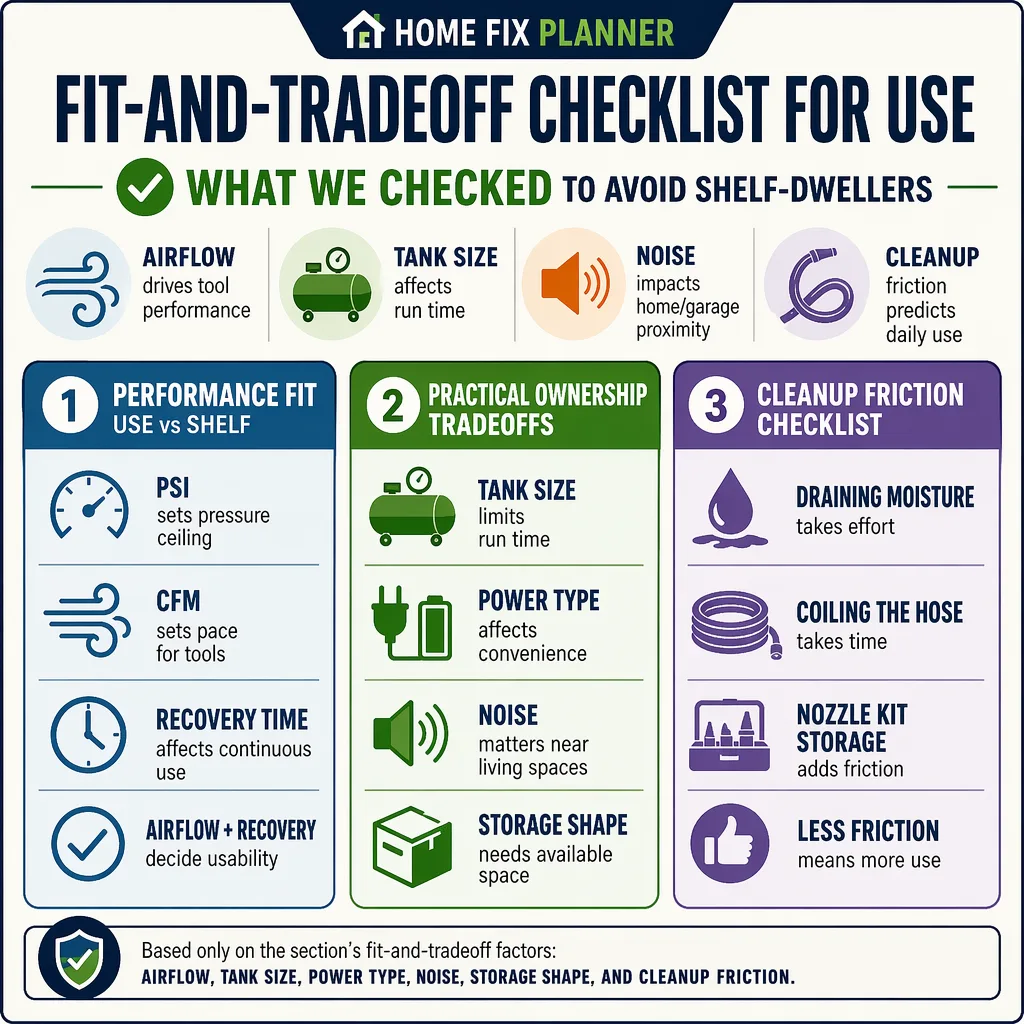
That matters more than glossy claims. A portable compressor looks simple on a product page, but ownership starts with the chores around it, draining moisture, coiling the hose, finding a place for the nozzle kit, and living with the noise if the garage sits close to the house.
Where It Makes Sense
This model belongs where convenience and occasional tool support beat raw output. It fits homeowners who want a single machine for tires, trim work, finish stapling, and garage cleanup, not a dedicated shop setup.
| Task | Fit | What matters | What breaks the fit |
|---|---|---|---|
| Tires | Strong fit for top-offs, seasonal checks, and roadside prep | Clear gauge, easy chuck connection, quick recovery | A clumsy hose or hard-to-read regulator turns a fast job into a nuisance |
| Trim work | Good fit only for brief bursts with a finish nailer or similar tool | CFM, recovery time, stable pressure delivery | Low airflow forces pauses that slow every cut and nail |
| Staple and finish work | Solid for intermittent fastening, not long runs | Accessory compatibility and hose reach | Odd fittings or weak output make the tool feel half-ready |
| Garage tasks | Useful for dust blow-off, filters, toys, and general cleanup | Noise, hose storage, and easy drain access | Messy cleanup and loud operation kill weekly convenience |
Best-fit boxes
Small storage
Best when the compressor parks on one shelf and the hose, cord, and accessories all stow cleanly.
Trade-off: compact housing gives up comfort on repeated tool bursts.
Occasional use
Best when tires and a few cleanup jobs are the main jobs.
Trade-off: extra output sits unused while the machine still needs draining and cord management.
Bigger DIY jobs
Best only when the compressor supports repeated fastening or longer garage sessions.
Trade-off: the step up in footprint and noise arrives fast.
Where the Claims Need Context
Most guides chase PSI first. That is wrong because PSI only shows the pressure ceiling, while CFM and recovery decide whether the compressor keeps up with tools. A high-pressure label does not rescue a weak pump.
Tank size also gets overrated. Bigger tanks smooth short bursts, but they do not fix poor airflow or make a loud compressor quieter. They add weight, storage friction, and more tank to drain after use.
Portability deserves a reality check too. A carry handle does not make the unit easy to live with if the hose wraps badly, the drain sits in a awkward spot, or the couplers fight common accessories. For first-time buyers, that is where the annoyance starts.
Cleanup matters more than most product pages admit. Moisture drains, hose wrap, and accessory storage decide whether the compressor stays handy or becomes garage clutter. If the model is awkward to drain or hard to stash, it stops feeling portable after week one.
Proof Points to Check for Portable Air Compressor
This is the section that separates a useful buy from a frustrating one. Before checkout, check the photos and manual for the details that do not shout from the headline.
- Standard fittings, a common coupler and hose setup saves money on replacement parts and accessories.
- Accessible drain valve, the tank needs an easy path to moisture cleanup, not a fiddly reach under the body.
- Readable regulator and gauge layout, if you squint to set pressure, the tool wastes time every use.
- Replacement parts and accessories, hoses, filters, gauges, and couplers matter in year two as much as day one.
- Storage points, a real place for the hose and cord keeps the garage from turning into a tangle.
The biggest hidden cost is friction, not electricity. A compressor with odd fittings or a poor layout loses convenience every time it comes off the shelf.
How It Compares With Alternatives
Against a cordless tire inflator, the portable compressor wins on hose reach and broader job support. It handles multiple tires more comfortably and brings enough punch for short-burst tool use. The cordless inflator wins when storage space is tight and the only job is occasional tire top-offs.
Against a larger shop compressor, the portable model wins on footprint and cleanup. It belongs in a home garage that does not justify a bigger machine. The shop compressor wins when repeated nailer work, sanding, or heavier pneumatic use is the real plan.
That comparison draws the line clearly. Buy the portable compressor for the middle ground, not for nonstop tool duty and not for a trunk-only inflation kit.
Fit Checklist
Use this before buying:
- Your main jobs are tires, blow-off cleanup, or short-burst fastening.
- You have a place for the compressor, hose, and cord, not just the unit itself.
- You checked airflow and recovery, not just the pressure label.
- You accept some noise in exchange for better reach and more use cases.
- You want one machine that covers more than emergency inflation.
Skip it if your only job is seasonal tire top-offs and you want the simplest possible carry solution. Skip it again if repeated trim work or heavy garage tool use is the real goal.
The Practical Verdict
Recommend a portable compressor if you want one compact machine for tires, cleanup, and light trim or staple work. It gives homeowners a real step up from a bare-bones inflator without forcing a full shop setup.
Skip it if you need quiet storage, no-drama maintenance, or sustained airflow for bigger pneumatic tools. In that case, a cordless tire inflator fits the simple-use lane better, and a larger shop compressor fits the heavy-use lane better.
Frequently Asked Questions
Is a portable air compressor enough for tire maintenance?
Yes. It handles tire top-offs, seasonal pressure checks, and roadside prep well, especially when the gauge and chuck are easy to use. If the only job is inflating a tire once in a while, a cordless inflator still stays simpler.
What matters more, PSI or CFM?
CFM matters more for tools. PSI sets the pressure ceiling, but CFM and recovery decide whether the compressor keeps feeding a nailer, stapler, or cleanup nozzle without constant pauses.
Does tank size matter more than power?
No. Tank size smooths bursts, but airflow and recovery matter more for actual work. A bigger tank with weak output still feels slow once the tool starts cycling.
What maintenance adds the most hassle?
Moisture draining, hose storage, and accessory organization. If the drain is awkward or the hose has nowhere clean to live, the compressor feels like a chore instead of a helper.
Should I buy this instead of a cordless tire inflator?
Buy the compressor if you want hose reach and light tool support. Buy the cordless inflator if storage space is tight and tire inflation is the only job on the list.
See Also
If you are weighing this model, also compare it with Milwaukee Stud Finder Review: How It Works and Why It Can Miss Studs, Tacklife Stud Finder Review: What It Does Well and Its Trade-Offs, and Hitachi Compound Miter Saw Review: What to Know Before You Buy.
For broader context before you decide, Flat Paint vs Satin Paint: Cleanup, Touch-Ups, and Durability and Klein Tools ET310 Review: A No-Nonsense Circuit Breaker Finder help round out the trade-offs.