The reolink doorbell camera is a sensible buy for a wired front door that wants local footage control and lower recurring cost. That answer changes fast if the entry has no usable doorbell wiring or the buyer wants the easiest battery-style install. It also changes if the home already runs on Ring, because switching ecosystems adds app and storage friction. This model earns attention when installation fit and clip control matter more than cloud convenience.
The Short Answer
The main win here is ownership control. Reolink leans toward a setup that keeps more footage access in the home and less of it tied to a monthly service plan, which matters more than flashy camera talk at the front door.
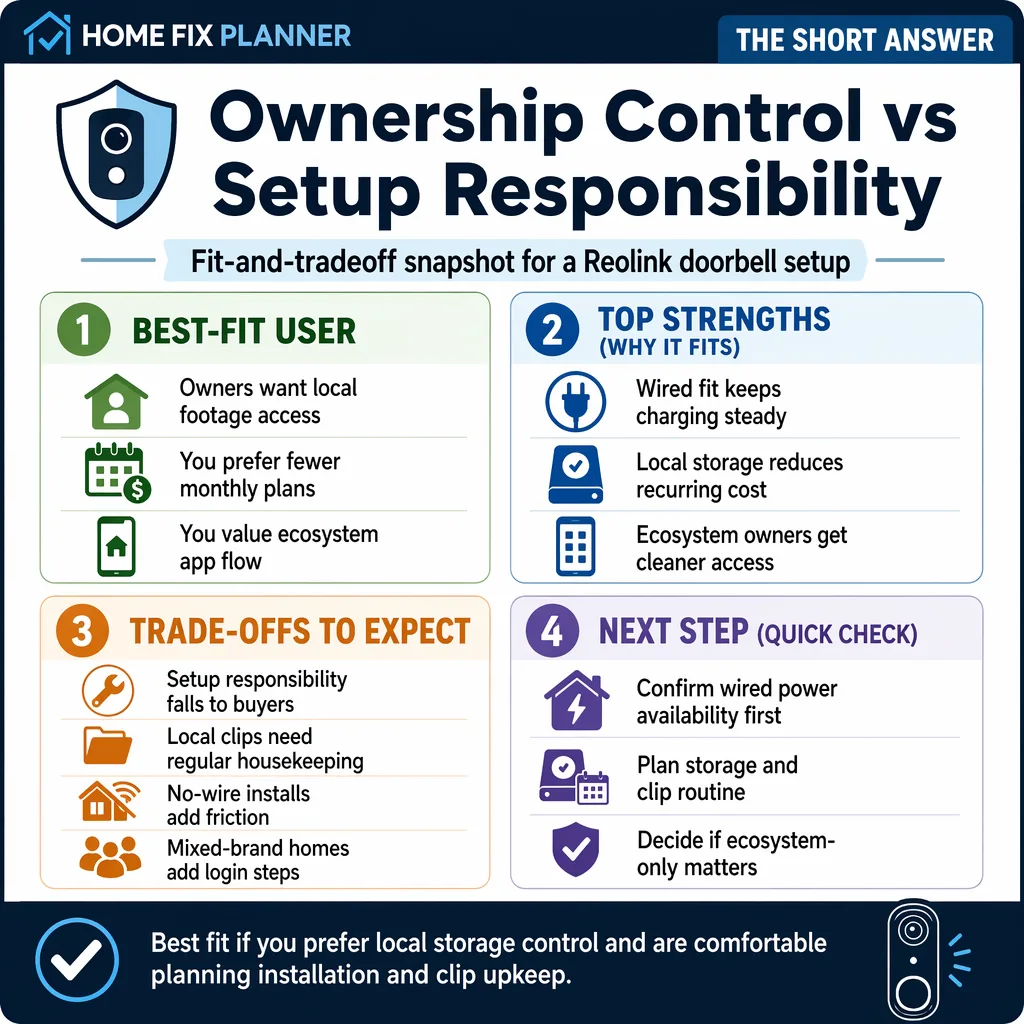
The trade-off is setup responsibility. Buyers handle more of the installation logic, storage choices, and clip housekeeping, so the experience rewards planning and punishes shortcuts.
Strengths
- Wired fit keeps charging off the calendar.
- Local storage lowers recurring cost pressure.
- Reolink ecosystem owners get a cleaner app and storage path.
Trade-offs
- No-wire homes face install friction fast.
- Local footage means more clip management.
- Mixed-brand homes add another login and another library.
Best-fit scenario: A homeowner with existing doorbell wiring who wants a camera that stays closer to local storage and keeps monthly costs down.
How We Framed the Decision
The right way to judge a doorbell camera is by the chores it creates. Power, storage, and app sprawl decide whether the camera becomes part of the home or another gadget that needs attention.
Most guides push image quality first. That is the wrong order. A crisp picture does nothing for a homeowner who has no compatible wiring, no clean place to store clips, or no patience for a cloud bill.
The exact bundle matters here. Reolink sells more than one doorbell setup, so the listing and included accessories deserve a close read before the rest of the buying decision gets built around the brand name alone.
The First Filter for Reolink Doorbell Camera
Start at the doorway, not the spec sheet. If the front entry has usable wiring, a stable mounting spot, and enough room for the bracket, this model stays in play. If the doorframe is cramped or the wiring is missing, the install friction becomes the whole story.
Pass these checks before buying
- Existing doorbell wiring is already in place.
- The chime plan is clear.
- The mounting spot gives a clean view of faces and parcels.
- The footage storage plan is already decided.
- You want a wired setup, not a battery routine.
The ecosystem question matters too. A Reolink doorbell inside a home that already uses Reolink cameras keeps the weekly app routine cleaner. In a mixed-brand home, one extra login and one extra clip library matter more than shoppers expect.
That is the quiet difference between a doorbell that feels tidy and one that becomes another small admin job. The best install is the one the household forgets about after the setup is finished.
Best-Fit Use Cases
This model fits homeowners who value fewer recurring fees and a more controlled footage path. It also fits buyers who want the front door to join an existing Reolink setup instead of starting a fresh app ecosystem from scratch.
Strong fit
- Wired single-family homes. The camera belongs here because the install path stays straightforward once compatible wiring is already in place.
- Reolink households. One app, one storage path, less weekly friction.
- Buyers who want local footage control. This is the crowd that gets the most from the model’s ownership style.
Poor fit
- Renters. The installation job and lease restrictions make this a clumsy choice.
- No-wire entries. A battery-first doorbell handles that job better.
- Cloud-first households. If the family wants the smoothest subscription-backed handoff, this is not the cleanest answer.
The recurring theme is simple: the product rewards a homeowner who accepts a little setup work in exchange for more control later. It does not reward someone who wants the least possible attention after the box is opened.
Weekly use stays easiest when the storage path is simple and the motion alerts stay focused on the front door, not the sidewalk, street, or passing cars. That is where planning beats marketing copy every time.
Where the Claims Need Context
A lot of shoppers hear “local storage” and stop thinking. That is too simple. Local storage lowers recurring cost, but it also puts clip management on the homeowner. Cloud-first systems shift that admin to a service, and the bill follows along.
| Decision point | Reolink lean | What it means for the homeowner |
|---|---|---|
| Wired vs. wireless | Wired-first | Less charging, more install planning if the doorway lacks ready power |
| Local storage vs. cloud | Local-storage-first | Lower recurring cost, but more clip and storage housekeeping |
| Budget vs. convenience | Value-leaning | Better for buyers who want ownership control, weaker for buyers who want the simplest cloud-first path |
Most people also miss the maintenance side. Outdoor cameras sit in weather, so dust, pollen, spider webs, and grime show up right where video quality matters most. A doorbell that looks low-maintenance still needs a quick wipe and a storage check now and then.
A few edge cases deserve a hard look before checkout:
- Busy street or walkway. Confirm motion zones and placement before buying, because false alerts turn useful alerts into noise.
- Narrow trim or awkward doorframe. Check the mounting footprint and any angle accessories before the order goes in.
- Used listings. A bare unit without the mounting pieces or power accessories turns into a scavenger hunt, not a bargain.
- Mixed-brand houses. One more app feels minor until everyone in the house needs the footage and nobody remembers which login owns it.
Most guides treat cloud backup as the safe default. That is wrong for many homeowners. The safer choice is the one the household will actually maintain without resentment.
What Else Belongs on the Shortlist
Reolink is not the only sensible answer. The better alternative depends on which annoyance you want to avoid, the wiring job or the subscription drag.
Ring Video Doorbell
Ring belongs on the shortlist when the household already lives in Amazon and Alexa territory and wants the most familiar mainstream app. It wins on convenience and household familiarity, especially for buyers who want the least explanation after installation.
The trade-off is the ownership model. Ring sits closer to a cloud-centered path, so buyers who hate recurring fees or want tighter local control get less from it than they get from Reolink.
Eufy Video Doorbell
Eufy belongs here when local storage matters but the install needs more flexibility than a wired-first Reolink setup. It is the closer alternative for buyers who want to keep footage closer to home without making Reolink the center of the camera system.
The trade-off is ecosystem gravity. If the rest of the house already uses Reolink cameras, Eufy adds another platform to manage for a single front-door job.
Simple rule: choose Reolink for wired homes and local storage control, Ring for the easiest cloud-first mainstream experience, and Eufy for buyers who want a local-storage story with more install flexibility.
Fit Checklist
Use this as the final yes or no pass before checkout:
- The front door already has usable wiring.
- The mounting spot has enough room for the bracket.
- You know where the video will live and who will manage it.
- Your household wants less recurring cost, not more cloud convenience.
- You already use Reolink gear or want to standardize on it.
- You are fine with a little setup work to avoid more admin later.
If two or more of those boxes stay unchecked, Ring or a battery-first Eufy belongs on the shortlist instead. That is the cleaner move than forcing a wired-first camera into the wrong doorway.
The Practical Verdict
The Reolink Doorbell Camera is a smart pick for a wired home that wants local storage, fewer recurring fees, and a cleaner ownership path. It is the wrong pick for renters, no-wire entries, and anyone who wants the simplest cloud-first doorbell on the shelf.
Recommend: wired homeowners, Reolink households, and buyers who want footage control closer to home.
Skip: renters, no-wire entries, and buyers who want the smoothest subscription-backed setup.
Ring wins the convenience race. Eufy sits closest if local storage matters but install flexibility matters too. Reolink wins when the home is already ready for a wired doorbell and the buyer wants the front entry to stay simple after installation, not before it.
Frequently Asked Questions
Does Reolink Doorbell Camera need a subscription?
No, the appeal of this model is keeping more footage control at home and reducing recurring cost pressure. Buyers who want a cloud-first, fee-backed workflow should look at Ring instead.
Is Reolink better than Ring?
Yes for wired homes that want local control and a lighter long-term bill. Ring is better for households that want the most familiar app and the cleanest Amazon and Alexa-adjacent experience.
What should a first-time buyer verify before ordering?
Verify wiring, mounting space, storage plan, and chime compatibility. Reolink sells more than one doorbell setup, so the exact listing matters more than the brand name alone.
Is a used unit worth buying?
Only if the mounting hardware and power accessories are included and the seller confirms the exact version. A stripped-down used listing turns a simple install into a parts chase.
What is the biggest mistake shoppers make with doorbell cameras?
They buy for the camera first and the doorway second. A doorbell works when the install path, storage path, and household workflow all line up, and that is the part most shoppers miss.
See Also
If you are weighing this model, also compare it with Tramex Moisture Meter Review: What U.S. Homeowners Should Know Before They Buy, Milwaukee Stud Finder Review: How It Works and Why It Can Miss Studs, and Hitachi Compound Miter Saw Review: What to Know Before You Buy.
For broader context before you decide, Flat Paint vs Satin Paint: Cleanup, Touch-Ups, and Durability and Klein Tools ET310 Review: A No-Nonsense Circuit Breaker Finder help round out the trade-offs.